Welcome to this in- depth analysis of the original Netflix series Squid Game that took the world by storm. Combining traditional Korean play with the dark side of modern society, let's claw into this shocking survival drama that charmed observers each over the world.
Squid Game, which was released on Netflix in September 2021, incontinently came a worldwide cultural phenomenon. It excelled the list in 94 countries and came the most successful series in Netflix's history, and was watched by 110 million homes within 28 days of its release. Created from director Hwang Dong- hyuk's original vision, the series goes beyond bare entertainment and raises sharp questions about class conflicts in Korean society, contradictions in capitalism, and mortal nature.
With 456 rivals jumping into the game for 45.6 billion won( roughly$ 38 million USD) prize money, the series transforms a familiar nonage game into a brutal competition between life and death. Red Light, Green Light( Mugunghwa Kkochi Pieot Seumnida), Korean traditional games analogous as dalgona delineation, and tug of war came as a stimulating shock to international spectators, which is one of the pivotal factors that enabled Squid Game to succeed worldwide.
In this composition, we will explore in depth the plot of Squid Game, the Korean cultural background contained in each game, the character analysis, and the communication this work transferred to the world.
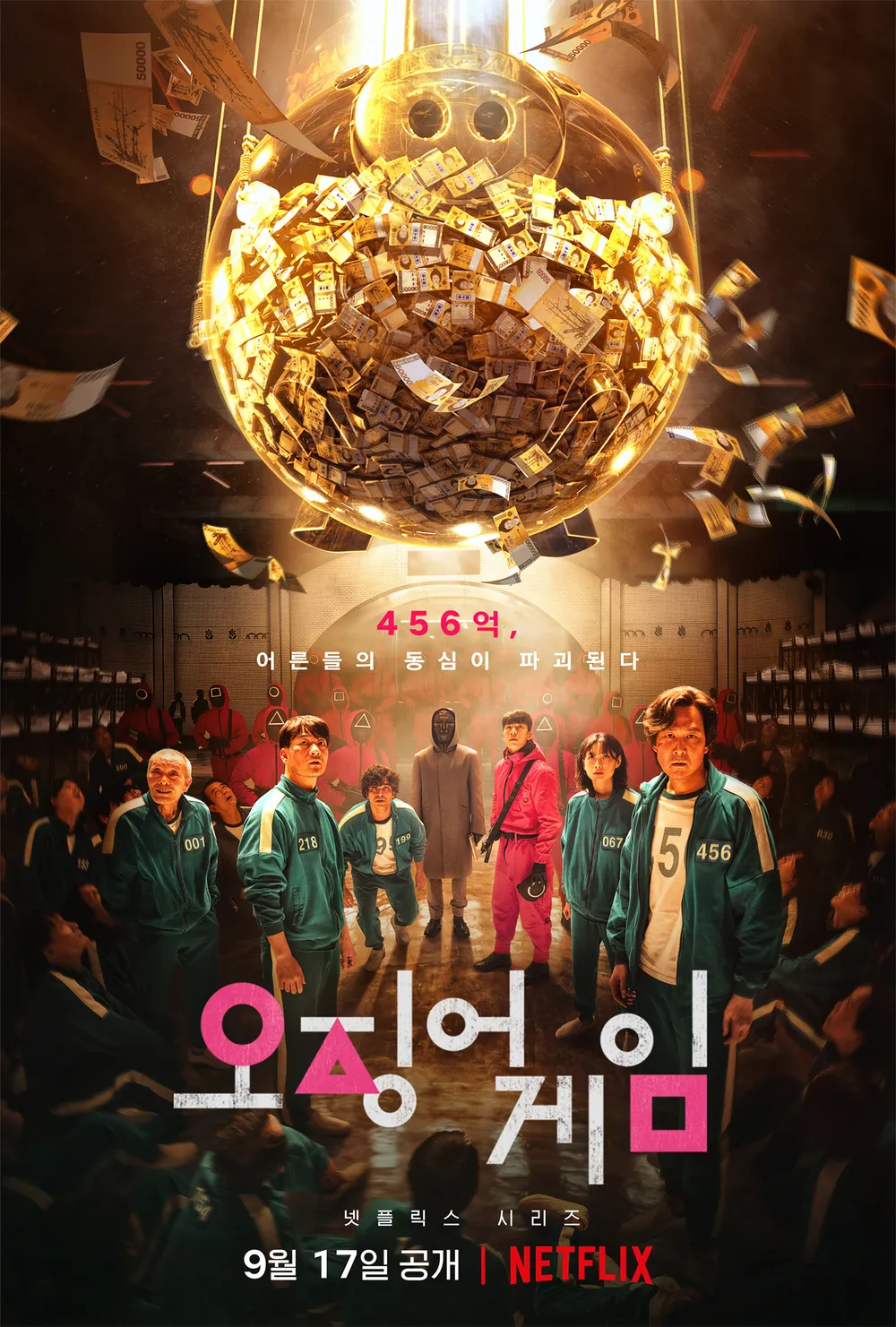
Squid Game Story
Squid Game tells the story of 456 debt- ridden people sharing in a survival game that risked their lives for 45.6 billion won.
The main character, Sung Ki- hoon( played by Lee Jung- jae), is a separated middle-aged man who's in hopeless need because of his gambling debt and his old mama 's hospital bills. One day at a shelter station, he receives a game assignation from an unidentified man and decides to share because he's obsessed with the large quantum of money.
Actors who arrive at the colosseum are given green tracksuits and figures. Under the vigilant eye of a director dressed in various pink and a frontman wearing crazy masks, actors must play a aggregate of six nonage games. still, they did n't realize that not being suitable to contend means death.
When hundreds of people are severely killed in the first game, Mugunghwa Bloom, actors are left affrighted. A vote is held to demand that the game be stopped, and the actors slightly reach a maturity and return to their diurnal lives. still, real debt and pain remain, and in the end, utmost actors freely decide to return the game.
As the game progresses, Sung Ki- hoon will meet with actors from colorful backgrounds, including his nonage friend Jo Sang- woo( Park Hae- soo), North Korean deserter Kang Sae- byeok( Jeong Ho- yeon), Pakistani worker Ali( Anupam Tripathi), and senior Oh Il- nam( Oh Young- soo).
Mugunghwa flowers similar as dalgona delineation, haul- of- war, blob- playing, stepping gravestone crossing, and the last game of squid game are in full bloom, and the number of actors in each round diminishments sprucely. As the game progresses, mortal nature and moral dilemmas for survival come clearer, raising deep questions for observers.
Who'll be the last survivor? And what's the verity of this cruel game?
Squid Game Traditional Play Explanation
The most unique element of Squid Game is that it transformed traditional Korean children's play into a survival game.
The six games that Korean children used to enjoy in alleys and playgrounds in the 1970s and 1980s were reborn as deadly games in dramas.
Let's take a closer look at the cultural background and rules contained in each game.
1. 무궁화 꽃이 피었습니다 (Red Light, Green Light)
The first game is Mugunghwa Blooming, one of the most popular children's games in Korea. In the English- speaking world, there's a analogous game known as Red Light, Green Light.
Game Rules
The rivals run forward while the tagger looks at the wall and says," Archery flowers are in bloom." When the tagger turns around after finishing his speech, he or she's excluded. In the drama, a giant robotic doll acts as a tagger, and when it detects movement, it's incontinently removed by firing.
Cultural Meaning
Mugunghwa is the public flower of Korea, and the name of the play reflects Korean identity. It was the most familiar play among Korean children in the 1970s and 1980s, and was popular because it was enjoyed without any special tools.

2. 달고나 뽑기 (Dalgona / Ppopgi)
The alternate game is a delineation game using' Dalgona', a traditional Korean road snack.
Game Rules
Stars, triangles, circles, and screens are stamped on the sugar- melted dalgona snacks. Actors must precisely shape them with a needle, and if they break the shape, they're excluded.
Cultural Meaning
Dalgona was an affordable snack that was common in front of Korean seminaries in the 1960s and'90s. It could be bought with a small quantum of money, like W10, and if you successfully pull out the shape, you would get one further. It symbolizes the simple pleasures of children in their poor days.

3. 줄다리기 (Tug of War)
The third game is haul- of- war, which is known each over the world.
Game Rules
It's a game that pulls strings in two brigades. In the drama, it takes place on a high platform, and the losing platoon crashes to death.
Cultural Meaning
Tug - of- war is a traditional game with a history of thousands of times in Korea. It was a folk game held at the vill position to supplicate for a good crop in the agrarian society, and it's still frequently seen during leaves and sports competitions. Cooperation and strategy are important games, and they contain a assignment that indeed if you're weak, you can win by strategy.

4. 구슬치기 (Marbles / Gonggi)
The fourth game is a variety of games using globules.
Game Rules
Two players platoon over and start with 10 globules each. Each player can choose the type of blob game he or she wants, and if he or she brings all of his or her opponent's globules, he or she wins. In the drama, the clunker dies.
Cultural Meaning
Marble- playing was the most popular play among Korean boys in the 1970s and 1980s. Glass globules were popular because they were affordable and could be played in a variety of ways. It was a game that allowed musketeers to witness fellowship and competition at the same time.

5. 징검다리 건너기 / 유리다리 (Glass Bridge)
The fifth game is a game acclimated for a drama.
Game Rules
You must cross a ground that consists of 18 dyads of glass panels. Each brace is made of tempered and regular glass, and it breaks and falls when you step on it. Actors must choose the correct glass in order to cross.
Cultural Meaning
The game was inspired by the nonage experience of crossing a stepping gravestone or a mean pole, rather than traditional games. There were numerous stepping monuments in pastoral aqueducts in Korea, and children played crossing them. It deals with the problems of luck and choice.

6. 오징어게임 (Squid Game)
It's the last game and the title of the work,' Squid Game'.
Game Rules
Squid- shaped delineations are made on the ground and divided into descent and protective brigades. The obnoxious platoon wins when it reaches the squid's head, and the protective platoon must help it. It's a violent game where physical contact is allowed, similar as pushing and diving .
Cultural Meaning
Squid Game was the most popular play among Korean boys in the 1970s and 1980s, but it's now nearly gone. It was enjoyed in narrow alleys or on the academy playground, and I frequently suffered from injuries due to physical intensity. Choosing the game as the title of his work is about the director's nonage nostalgia.
AI-generated depiction of A symbolic illustration

Squid Game Cultural Background
Squid Game is a social critical drama that goes beyond bare survival suspensers and reveals a dark side of ultramodern Korean society. The 456 rivals in the film are each in debt for different reasons, but they're all left before in the ultramodern commercial society. In this section, we will take a look at the structural problems of Korean society that Squid Game reflects.
Korea's Debt Problems and profitable Inequality
The biggest reason that Squid Game actors risk their lives to share in the game is because of" debt." This reflects a serious problem in ultramodern Korean society.
As of 2020, South Korea's ménage debt exceeded 100 percent of its GDP, one of the loftiest in the world. numerous Koreans live with lifelong debt due to casing loans, education charges, business failures, and medical charges. Sung Ki- hoon's gambling debt in the drama, Kang Sae- byeok's debt during his dereliction, and Cho Sang- woo's embezzlement debt all emblematize the colorful debt problems that real Koreans face.
In Korea, in particular, the culture of inordinate lending has surfaced as a social problem to the extent that the new word" spiritual"( to draw up a loan by raising the soul) has been chased. Surging real estate prices beget the youngish generation to owe hundreds of millions of won to buy a house, which becomes a lifelong burden.
Impossibility of scale movement
Squid Game shows how delicate class rise is in ultramodern Korean society.
In the 1970s and 1980s, Korea achieved rapid-fire profitable growth and believed that it could be successful if it tried as the saying goes," It's a dragon from the sluice." still, as profitable growth has braked since the 2000s and wealth polarization has boosted, it's now the time for parents' profitable power to determine their children's future.
The drama's rivals dive into a game of despair that they can noway pay off their debts or succeed in a normal way. This reflects the frustration of Korean society, which feels that it's no longer possible to climb the scale by legal and maintainable means.
an educational and academic society
Cho Sang- woo's character represents Korea's academic community.
In Korea, academic background from a prestigious university is an important criterion for judging an existent's value. Cho is from Seoul National University, but he nonetheless suffers from profitable failure and participates in games. This shows a change in ultramodern Korean society that academic background alone can no longer guarantee success.
Korea's inordinate enthusiasm for education is world- notorious. Parents spend astronomical private education to shoot their children to good universities, and scholars spend their nonage in violent competition. But indeed if they get a good academic background, they still face job difficulties and fiscal difficulties.
Demarcation against foreign workers
Ali's character, a Pakistani worker, shows the demarcation and exploitation endured by foreign workers in Korean society.
Korea began to accept foreign workers in manufacturing and construction sectors in the 1990s. still, they frequently suffer from overdue stipend, poor working conditions, and demarcation. In the drama, the scene where Ali is n't paid by his master and injures his cutlet reflects the problems that real Korean foreign workers face.
Korea is a country with a strong sense of monolithic people, and prejudice and demarcation against nonnatives still live in the process of transitioning to a multilateral society
the poverty problem of the senior
The Oh Il- nam character symbolizes Korea's serious poverty problem for the senior.
Korea has the loftiest senior poverty rate among OECD countries. Due to rapid-fire aging and inadequate pension systems, numerous senior people suffer from fiscal difficulties, and some have to work indeed in their 70s and 80s to earn a living.
Traditionally, there has been a culture in Korea of children supporting their parents, but nuclear families and profitable difficulties have also weakened these traditions. Seniors are frequently insulated financially and emotionally.
Review of capitalism
Squid Game contains sharp review of an extreme commercial society.
The superstars who host the games represent theultra-wealthy, and they enjoy the survival games of the poor as entertainment. This shows extreme wealth inequality and loss of humanity. They condemn a society where everything is converted into money and indeed mortal life is measured by the value of money.
The" equivalency"( all wear the same clothes and get the same occasion) given to actors is only fair on the face, but actually like a jungle of the jungle of the jungle of the jungle of the jungle of the jungle of the jungle of the jungle of the jungle of the jungle of the jungle of the jungle of the jungle of the jungle of the jungle of the nation's capitalism. It sends a communication that the conception of" fair competition" supported by the commercial society can actually be fabrication.
Squid Game General Review
Squid Game is a groundbreaking film that has taken the world by storm since its release on Netflix in 2021, opening a new horizon for Korean dramatizations. With the perfect combination of rudiments from survival suspensers, social commentary, and mortal drama, the series impressed and left observers with questions beyond bare entertainment, it delivers a important communication about ultramodern society.
excellence in product
Director Hwang Dong- hyuk has shown remarkable commanding chops through his work, which he conceived for further than a decade. The idea of transubstantiating pure nonage play into a life- and- death game is genius in itself, and the way it visually embodied it's cultural.
The various set designs and geometric structures produce a fairytale- suchlike atmosphere, while the violence and death in it stand in stark discrepancy. directors dressed in pink, prize money piling up in giant piggy banks, various stairs and dormitories give a surreal print as if looking at a world in a brutal puck tale.
The product of each game scene delicately captures mortal psychology and feelings while maximizing pressure and suspension. In particular, the complexity of mortal connections and the pain of treason shown in the blob- playing occasion impressed numerous observers.
excellent amusement chops
Lee Jung- jae gave his career-stylish performance through his part as the main character Sung Ki- hoon. He convincingly expressed the complex inner side of a person who seems unskillful and selfish, but is unnaturally good, and naturally portrayed the process of change and growth through games. Lee has also entered transnational recognition for his performance, earning him a nomination for the stylish actor at the American Emmy Awards.
Park Hae- soo was an elite, but he bettered in expressing mortal duality through his part as the fallen Cho Sang- woo. He played a cool- headed, calculated but at the same time convincingly played the psychology of a character who suffers from guilt and fear.
Despite being a novitiate, Jung Ho- yeon brought her tough yet fragile character Kang Sae- byeok to life. Her performance entered great transnational attention and latterly set the stage for her Hollywood career.
Oh impeccably embodies the image of a warm yet mysterious old man as the part of an oilman, and his performance still leaves a deep print after the twist is revealed. He won the Golden Globe Award for Stylish Supporting Actor for this performance.
social message and universality
One of the biggest success factors of Squid Game is that it has touched on universal themes that viewers around the world can sympathize with while dealing with the special problems of Korean society.
The contradictions between debt and poverty, class conflict, and capitalism are not unique to Korea. Addressing the deepening gap between the rich and the poor, competition for survival, and loss of humanity around the world, the work has formed a cross-border consensus. For people all over the world experiencing economic difficulties after the COVID-19 pandemic in the 2020s, the drama felt like their own story.
Questions like "Can money really solve everything?" "Can we abandon humanity for survival?" and "Is competition really fair in our society?" make viewers ponder deeply.
Visual aesthetics and symbolism
Squid Game is also a highly elaborately designed work visually. The use of color has symbolic meaning beyond just aesthetic purposes.
The participants' teal tracksuit reminds them of inmate or patient clothes and symbolizes their helplessness. The managers' pink outfits represent a duality of looking sweet and pure, but actually brutal violence. The golden masks of VIPs represent their greed and inhumanity.
Stairs, maze-like corridors, and geometric spaces reminiscent of Escher's paintings visualize systems that participants cannot escape from. The prize money that falls on a giant piggy bank directly shows the harshness of capitalism, where human life is converted into money.
Global Response and Impact
Squid Game came the most successful Netflix series in history, beating Netflix in 94 countries. It caused a artistic miracle, not just conditions.
Making dalgona came a worldwide trend, and the" Mugunghwa is Blooming" play was recreated in numerous countries. Green sportswear and pink directorial vesture came the trend for Halloween costumes and caused social impacts, similar as a flood tide of factual calls to phone figures in the work.
His work has been honored at numerous transnational award observances, including six Emmy Awards, and he came the firstnon-English-speaking drama to win an Emmy Award for Stylish Picture. This is a literal event that has taken the status of Korean dramatizations and indeed Asian content to the coming position.
Limitations and review
Squid Game is not the perfect piece, of course. Some critics refocused to its exorbitantly violent scenes and sensationalism, with some saying the story's development was predictable. It was also praised for its awkward performance by personality characters in the ultimate half of the season.
These minor excrescencies, still, are n't enough to obscure the overall achievement of the work. Squid Game impeccably combines kidney fun and social messaging, and deserves to be considered one of the stylish dramatizations of the 21st century to impress observers each over the world.
conclusion
Squid Game is an innovative piece that combines traditional Korean play with the dark reality of ultramodern society to achieve unknown global success. Director Hwang Dong- hyuk's outstanding product, actors' passionate performance, elaborate visual aesthetics, and utmost of all, sharp review of the ultramodern commercial society have been combined to produce a artistic miracle that goes beyond bare entertainment.
It explores mortal nature, moral dilemmas, and the unfairness of social structures within the kidney frame of survival games, and asks uncomfortable but necessary questions for observers. The record of No. 1 in 94 countries is n't just a number, but reflects the anxiety, frustration, and desire for change that people each over the world feel in common.
Squid Game has formerly opened up new possibilities for Korean content and will go down in history as a monumental work that has raised the bar for drama product around the world to the coming position thanks to the explosive fashionability of season one. The characters' attempts to save their humanity to the end despite the brutal game make us all suppose again about what a real palm is.